Feeds:
Posts
Comments

Born in 1909, Sarah Jones lived in the small town of Cynthiana, Kentucky. Much of my great-grandmother’s life was spent on a farm, and my mom always likes to tell stories about watching tiny chicks in the incubator as a kid. By the time I came around, or at least as far as my memory goes, the farm was gone. I remember a field of flowers. I remember that we had to take long, winding roads to get to her house, and I would usually throw up because I’m prone to motion sickness. And I remember that she made the only green beans I enjoyed eating as a child.

Then I grew up, and even though the highway made it easier to get to her house, I didn’t see my great-grandmother much. I guess I was busy being a teenager in Cincinnati and then trying to be an adult in lands far away. She died at 98, and the last time I visited her we ate slices of her famous jam cake at the kitchen table, laughing as we picked the blackberry seeds from our teeth.

My aunt recently gave me the recipe, which calls for a large bundt pan, but she said she often makes small loaves to give out to people around the holidays. My friends and I got together for a baking extravaganza and used mini-bundt pans that made individual servings.

Sarah Jones’s Kentucky Jam Cakes

  • 1 c butter, softened
  • 2 c white sugar
  • 6 eggs
  • 3 c flour
  • 1 tsp baking soda
  • 1/2 tsp salt
  • 1/2 tsp allspice
  • 1/2 tsp cloves
  • 1 c buttermillk
  • 1 c seeded blackberry jam
  • 1 c nuts
  • 1 c raisins

In a mixing bowl, cream butter and sugar and mix in eggs one at a time. In a separate bowl, sift flour, salt, and spices. Whisk baking soda into buttermilk and add to egg mixture. Add flour mixture gradually, beating smoothly, and stir in the remaining ingredients.
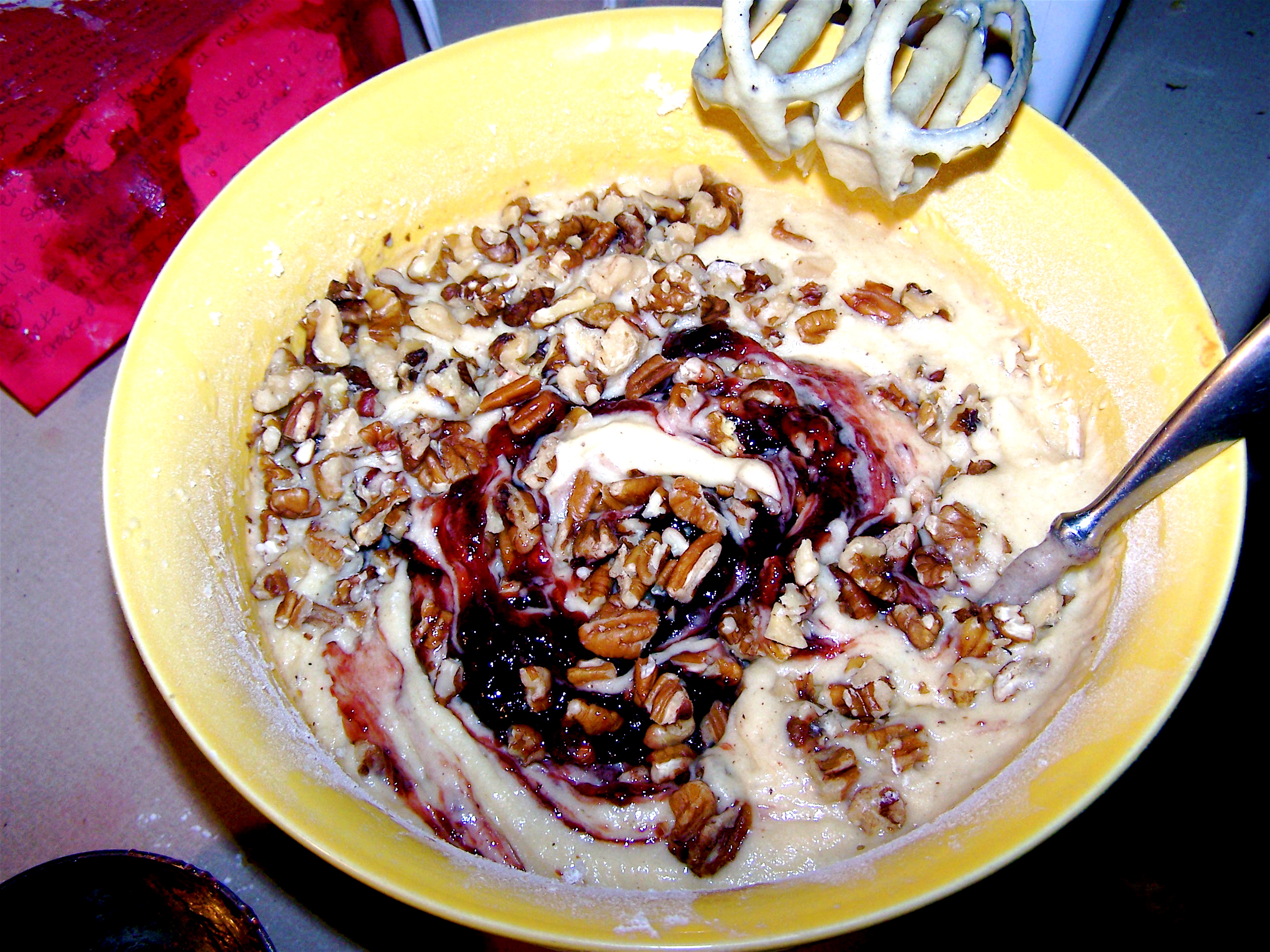
Pour into a greased bundt pan. Bake at 325 for 65 minutes or until a toothpick comes out clean. (I think we baked the mini-bundts for about 25 minutes). The directions say to start out on the bottom rack and transfer to the top halfway through, but we didn’t do this and our minis turned out fine.

You can eat them as is, but they are best with my great-grandmother’s caramel frosting. Actually, that’s the best part!

  • 2 c light brown sugar
  • 1 c granulated sugar
  • 2 tbs corn syrup
  • 3 tbs butter
  • 2/3 c heavy whipping cream
  • 1 tsp vanilla

Mix all ingredients except for vanilla and bring to a rolling boil. Cook 5 minutes and add vanilla. Let cool until it begins to thicken. Frost away!

Admittedly, I couldn’t figure out the best time to frost the cakes. At first, it didn’t seem cool enough–too runny–but then suddenly it was pretty stiff. I was able to go back over the cakes after frosting and smooth them out to some extent. Alternatively, you could try pouring the frosting over the top of the cake while it’s still warm.

If you make miniature versions, pop yours into the microwave briefly before you eat it for a warm and festive New Year’s treat. I’m curious to hear if you have any cherished family recipes that remind you of a special moment in your life.

Have I told you that fall is my favorite? It’s particularly welcome after a sweltering summer. I’m always excited to switch the oven on and bake, roast, and broil. I love pulling on a pair of corduroys and a thick sweater for a long walk. I love the smell of falling leaves and crisp air. It’s Halloween and Thanksgiving. It’s time to get cozy.

I also love root vegetables. I know they’re not so popular, but I think most people just haven’t bothered to find out how versatile and satisfying veggies like turnips, parsnips, beets, and rutabagas can be. When The Captain and I lived in Poland, we ate loads of root vegetables and never got tired of them. They are full of flavor and perfect for the sort of warm, comforting dishes we require as the weather turns colder.

You don’t often see root vegetables in pasta dishes, but you can pair them with any grain. With a sage-infused cider cream, this dish becomes a showcase for autumn treats. Enjoy it with a crisp reisling or a good hard cider. This recipe serves four.

Fall vegetable penne with sage-cider cream sauce

  • 5 cups root vegetables, any combination, cut into 1-inch pieces
  • 1 tbs olive or grapeseed oil
  • 1 tsp sea salt
  • 8 oz. whole-wheat penne
  • 1 cup apple cider
  • 1 tbs sage, chopped
  • 1/2 cup heavy cream

Preheat oven to 425. Put the veggies, olive oil, and salt in a bowl and stir to coat. Plop them onto a baking sheet and cook for about 40 minutes or until tender.

Near the end of cooking time, boil the pasta and start the sauce. Cook cider on a low boil until reduced by half. Turn down heat and add sage and cream. Simmer for a few minutes to let the flavors mingle.

Mix the veggies and pasta together and pour sauce into dish, stirring to combine. Sprinkle some fresh sage over the top.

Going to San Francisco

I’ve always wanted to go to San Francisco. One of our good friends from the time we lived in Poland is from California and goes to grad school there. We got to see her after five years, and it was a wonderful reunion, like no time had passed. Cap and I sorely needed this vacation after a few crazy weeks at home. We were itching to get away and relax, and neither of us had ever been to northern California. The above photo is of the famous painted ladies of Postcard Row. I’ve always loved the idea of them.

We did lots of shopping in Hayes Valley, Haight, the Mission, and Fillmore Street. I got some artisanal chocolates from Cocoluxe, three types of dark-chocolate-covered goodies all locally sourced: spiced figs, pine-nut and sage toffee, and honeycomb. Cap, of course, spent several hours flipping through record bins at Amoeba and Aquarius. I enjoyed wandering around all the cute boutiques like BellJar, Needles & Pens, and Sunhee Moon (where I fell in love with this Dia de Los Muertos dress but didn’t buy it), and we inspected the peg legs and beard extenders at 826 Valencia, Dave Eggers’s writing center/pirate supply store. I tried French macarons for the first time, entranced by their bright hues and intriguing flavors like earl gray tea and violet cassis, but they looked better than they tasted. I guess I’m not really a macaron gal.

Our friends took us to one of their favorite restaurants, Suppenkuche, a Bavarian wirtshaus. White-washed walls, rustic pine tables, and a ceiling dangling with dozens of “radvogel,” or “bicycle birds,” sleek, metal birds in flight, seem spare at first but the addition of candlelight and jolly, red-faced patrons makes for a cozy and unique atmosphere. Most guests squeeze in next to strangers on the long benches, joining in the communal feeling, but we sat in a snug room on the back side of the bar, which was dark and mellow. They serve beer in half-liters but also in glass boots the size of The Captain’s calf, so of course he had to get one. I think it held two liters. I enjoyed an average-sized Schneider Weisse Hefeweizen. I am a wheat-beer kind of girl.

But it’s the food I must rave about. You wouldn’t think vegetarians would find much to satisfy them at a German restaurant, but Suppenkuche came through for us. Gemischter Salat (Mixed German Salad) came with four kinds of cold salads: shredded carrot, pickled beet, potato, and sauerkraut. If I lived in San Francisco, I’d pop into Suppenkuche all the time for salad and a beer. Very satisfying. All four of us shared the salads before digging into Cheese Spatzle with Onion Butter Sauce, which I am still craving a month later. Okay, if I lived in San Francisco, I’d be full of spatzle and beer. I have to figure out how to recreate that dish.

I had the best stout of my life at Magnolia Pub, a former apothecary on Haight Street. Stout of Circumstance was smoky, and The Captain’s seasonal ale smelled of apricots. A plate of local pickled vegetables made a good afternoon snack. Another favorite food/drink experience was the rosewater-cardamom ice cream at Bombay Ice Cream on Valencia. They had other exotic flavors (saffron, pistachio, basil seed), but Cap got rocky road for some reason. He could have at least ordered the banana rocky road, but he opted for the regular chocolate. We also had delicious burritos, noodles, and Ethiopian food, a cuisine we can’t get back here in Tennessee. And I can’t forget Samovar, a cool tea lounge, where we had Cherry Oat Scones with Devonshire Cream and Strawberry Jam alongside a steaming pot of Ocean Wisdom Herbal Blend created for His Holiness The Dalai Lama. The scones were flaky and hit the spot before a long day of shopping and sightseeing.

And there is so much green in San Francisco. It’s like a big city with a neighborhood feel. We wound our way through Buena Vista Park, cut through the trails of the Panhandle, and climbed up to Alamo Square to get a glimpse of the classic San Francisco view (in the photo at the top of this post). I hope all the walking balanced out all the eating.

On our last day, I picked up some breakfast from a farmer’s market and snagged some adorable Betsey Johnson dresses before the four of us picked up sandwiches and piled into the car for a hike up to Point Bonita Lighthouse and a picnic on Rodeo Beach in the Marin Headlands. Point Bonita offered a fantastic view of the bay and Golden Gate Bridge as well as friendly seals playing in the water. Rodeo Beach was pebbly and dotted with surfers and dogs. We relaxed on a blanket and watched the Blue Angels loop and roll across the sunny sky.

Unsurprisingly, The Captain now wants to move to San Francisco. Maybe someday. In the meantime, how can we turn our house into a painted lady?

Garden sorrel and potato soup

Since the temperature is finally cooler, the greens are raging. The sorrel in my garden looked crisp and vibrant and since it’s soup weather, ready to toss into the pot. This isn’t your average potato soup. It’s creamy and sumptuous, yes, but sorrel is citrusy with a tangy bite. It’s the perfect foil for the cream. You can puree the soup before or after you add the sorrel, but I don’t think it’s necessary. I like something to chew.

Sorrel (aka sour sabs, sour suds, cuckoo sorrow, cuckoo’s meat) is a perennial herb or leafy green. The lemony flavor, which deepens as it ages, comes from oxalic acid, so people with kidney stones should avoid it in large amounts. Young leaves can be used in salads, but older leaves are best for flavoring soups. Sorrel is high in vitamin C and can prevent scurvy, if that’s a concern for you. It’s not easy to find at the market, but it’s easy to grow in the garden.

This is a quick recipe for a comforting soup on a windy fall night.

  • 2 tbs butter
  • 1 onion, chopped
  • 1 leek, sliced
  • 1 cup celery, sliced
  • 1 lb potatoes, chopped
  • 4 cups vegetable stock
  • 1 bunch sorrel
  • 1 cup cream
  • Salt and pepper to taste

Melt butter in a large pot and saute onion, leek, and celery until translucent. Add potatoes and stock and simmer until potatoes are tender. (If your stock isn’t very flavorful, you might want to add a dash of tamari, an excellent flavor enhancer.) Stir in sorrel. The verdant green will immediately turn to a drab olive. Add cream, stirring to be sure it’s fully incorporated. Adjust seasonings if necessary and serve with hearty multi-grain bread.

And it makes a delicious treat for lunch the next day.

Cycle of life

Recently, we had a death in the family, and things were crazy for a bit. It’s had me thinking a lot about what I love in life. I feel like I could spend forever making a list: the sound of The Captain’s laughter, calling my mom when I’ve had a bad day, inside jokes with my siblings, Thursday nights with the ladies (including impromptu Beyonce dance lessons and YouTube karaoke), fall hikes, the reddest October leaves, winter silence, spring mornings, watching birds fly, herb gardens, my giggling niece, the way my feet sink in the sand when the tide rushes back out, digging in the dirt, finding myself unable to think about anything but the book I’ve been reading, collard greens, cupcakes, a long walk….

More recently, we had a wedding in the family, and it was an inspired celebration of life. Dear friends, two of the kindest, most genuine people you could ever meet, got married at the Highlander Research and Education Center. Just outside of Knoxville, Highlander is a famous popular education organization involved in building the labor movement, civil rights movement, support for Appalachian people, and immigrant organizing. It also happens to have one of the most phenomenal views of the Smoky Mountains.

Both the bride and groom are artists, and she made her awesome dress out of crinkled paper. Guests were asked to wear sparkly attire, and the place was full of glitter, sequins, shiny suits, crafty ties, and a general wildness. The bride walked down the aisle to music provided by another friend on a drum set, and a few people in the audience played tambourines and egg shakers at certain moments. It was dramatic and beautiful. Someone read a poem by Mary Oliver, the bride reached repeatedly for her handkerchief, and the sweet groom cried a bit during his vows and fell silent here and there to collect himself. We were all grinning like fools, in love with their love.

It’s a wonderful thing when people you care for share their love with you. When you know those two people were made for each other, everything feels good and right in the world, for a moment at least. It’s a blessing.

Shiitake bacon!

This is my latest obsession. I’ve been a vegetarian for fifteen years, and I don’t miss any meats. None. But I do miss certain dishes like my dad’s grilled ham and cheese and my mom’s turkey chili, so sometimes a meat substitute is called for. Sometimes you just need that extra heft, that oomph that really makes a dish comforting and substantial. This is particularly true of sandwiches. Veggie sandwiches can be wonderful, but sometimes I just want a little more: some good baked tofu, grilled tempeh, Tofurkey. The Night Owl Cafe, a newish little spot in Knoxville’s Old City has a sandwich that is to die for. They layer havarti and arugula on toasted bread, smear it with the most flavorful carrot spread, and top it with shiitakes that have been roasted for so long that they taste like bacon.

Seriously, you must try this stuff. A quick search online gave me a good idea of how to turn mushrooms into bacon. Basically, you marinate them in tamari with a touch of liquid smoke and then roast them at 400 for 30-35 minutes. It’s a bit tricky, and I’m going to have to experiment a bit because I cooked mine a little too long and some just tasted burnt. They also needed more tamari because saltiness is crucial. But while they were cooking, they filled the whole house with a comforting, mapley bacon smell, made all the more satisfying by the knowledge that the smell wasn’t coming from fried pig.

I decided to throw them into pasta. I roasted butternut squash in a pan next to the shiitakes, cooked sliced onions until they caramelized, and stirred a bunch of garden sorrel and softly fried eggs into spaghetti. It was good but not quite what I had imagined. Even though sorrel is supposed to go with each of those ingredients, its strong citrus flavor was too much, so I would replace it with spinach or even kale. Also, I made the mistake of stirring the shiitake bacon into the pan when I should have simply sprinkled it over the top of the dish to keep the mushrooms from soaking up too much liquid and softening. We want crispy shiitake bacon!

If you play around with shiitakes, let me know how yours turn out. I’m curious about what kind of recipes would be best to sneak them into. Keeping that crunch is essential for me. Ooh, maybe a BLT?

Tomato pie

Last weekend we went to see The Kids Are Alright. It was great, but that’s not the point. In one scene, Mark Ruffalo loads a basket of freshly picked veggies into his truck from a thriving garden he uses for his restaurant. He grabs a bright red tomato, and, just before hopping up into the cab, he takes a giant bite out of the tomato like it’s an apple. So juicy. I coveted it.

To me, tomatoes taste like summer. Here I am in August oven drying cherry tomatoes, slowly simmering too-soft tomatoes into marina sauce, pickling green tomatoes, and slicing Romas into everything I can get my hands on. Slurping a sun-warmed tomato just picked from the vine is the best way to enjoy this delectable fruit, but there’s one dish that best showcases it: tomato pie. So tangy, so luscious, so tomatoey.

This recipe calls for a butter crust, which I think is crucial. The buttery flakes pair up with the acidic tomatoes perfectly. But if you’re making a heavier pie with loads of cheese, you might want to consider a lighter olive-oil crust. Serve with a salad, and do it now while there is a bounty of shiny red tomatoes. This is the kind of thing you’ll crave come winter.

Tomato pie

  • 1 stick butter, cold, cold, cold
  • 1 1/4 cups flour (preferably white whole wheat)
  • 1 tsp sugar
  • 1/2 tsp salt
  • 1/2 cup ice-cold water
  • Around 4 cups tomatoes, sliced
  • 1 tsp sea salt
  • 2 tbs fresh basil, chopped, plus extra for sprinkling on top
  • 1/3 cup mayonnaise or Vegenaise
  • 1/3 cup parmesan

First, make the crust. Dice the butter into little bits. Sift the flour, sugar, and salt together, and sprinkle in the butter bits. Mix with your fingers, a pastry blender, or mixer until the butter bits are even bittier, like teeny pebbles. It’s okay if some are bigger than others because that helps with the flakiness. Mix the water in to the dough. You may end up needing a little extra, and that’s okay. Knead, wrap, and put in the fridge to chill for at least one hour.

Once your crust is cold enough to work with, roll it out and press it into a 9-inch pie pan. Bake crust for ten minuted, remove, and fill with the tomatoes. Sprinkle with salt and basil. Mix the mayonnaise and cheese together and spread over the top. Bake at 350 for approximately 35 minutes.

I’ve long suspected that I need to move farther south, and a recent trip to South Carolina was all the confirmation I needed. Our friend Claire grew up on Kiawah Island (must have been nice), but her parents now live in Georgetown, which is a little historic spot on the coast between Myrtle Beach and Charleston. And they win the award for sweetest hosts on the planet. Claire’s mama even had cookies waiting for us.

The old rice fields

Live oaks lead the way to the house

We arrived in the evening, and after a satisfying meal at a local seafood/barbecue/southern buffet joint, we grabbed flashlights and ambled through the neighborhood, a former rice plantation, to the sandy path that leads to the marina at the Sampit River. We were in search of alligators. I must admit that I was a touch frightened, but it was one of those instances where the fear gives you a thrill. I had never seen an alligator in real life and was reminded of all the people who spot a bear in Cades Cove, get out of their cars, and creep up to take a picture. Everyone knows this is stupid, right?

We walked out onto the marina, feeling a bit glum at the sight of still water, but when our flashlights hit the surface, something incredible happened. A phalanx of gators were slowly moving toward the marina. The light made their eyes shine red like beady devil eyes. That was all we could see at first. It was like being surrounded by monsters! Once our eyes adjusted a little more, we could sometimes make out their snouts.

On the marina, we were only about three feet from the water no matter where we stood, and I felt like gators were going to attack us from behind. I kept turning in circles. One gator was making his way toward the shore, so we decided to get there before he did and head back to the house. The Captain and a few others lingered longer than I could take. I saw that gator’s tail flip up from the water, and he was not small. I knew what to do when approached by a bear, but what about a gator? Claire told me to run in a zig-zag. Apparently, they can’t turn fast enough.

On our first full day, Claire’s papa took us out on his speed boat to a private island, where we could sit in the calm, warm salt water on one side and watch the mighty waves from the Atlantic crash to shore on the other. Everything about it was beautiful and relaxing, except when I thought some kind of little worm was stinging my thigh. It turned out to be a stray jellyfish tentacle, but it wasn’t too bad. After a few hours, storm clouds began to gather, so we went home and made a Lowcountry shrimp boil called Frogmore stew, Cajun tofu salad, and cherry pie.

The next day we visited McClellanville, a small shrimping village where Claire’s grandparents live. It was like going back in time and also a little like Bon Temps if Sookie Stackhouse lived near the coast: fewer than 500 people, nineteenth-century houses, live oaks, Spanish moss, palmettos, rundown shacks, a mayor named Rutledge B. Leland III. And it’s surrounded by Frances Marion National Forest. I wanted to live there and run the little bookshop.

We had lunch at an idyllic seafood restaurant, which fried up some of the best hushpuppies I’ve ever had. We went to pick figs at the grandparents’ house but didn’t find many ripe ones. We did, however, find random crabs crawling through yards, dolphins playing in the salt marsh, and a tiny frog living in the cabbage patch.

Unripe figs

A surprise!

Salt marsh

A dinner bell to call people home from fishing

A sunny afternoon meant another trip to the beach, but this time we went to Huntington Beach, where we could play in the waves. I’ll let the pictures speak for themselves. Oh, but when we were leaving, we saw an alligator resting on the shore of the lagoon. We pulled up right alongside it in our car. (I have to apologize because I did not get any gator pictures.) Back at the house, we still had enough energy to make crab cakes, grilled vegetables, and margaritas.

Before leaving the following morning, we wandered around downtown Georgetown, staring longingly at the historic homes, eating chocolate-covered macaroons, and picking up locally grown rice and tea to take back home. It was even hotter than Knoxville, but I didn’t want to leave. I wanted Spanish moss in my trees! I took one last walk to the marina but heard something crash through the trees next to the shore. I turned around and retraced my steps, afraid I’d have to run in a zig-zag all the way back to the house.

Historic Georgetown home built in 1734

500-year-old live oak

The yard share is pushing out tomatoes faster than we can pick them, so I decided to dry some. Drying tomatoes in the sun takes ten to twelve days of dry weather, and although it’s certainly hot enough, we’ve had little baby storms here and there and so much humidity that I feel like I’m taking a hot bath with everyone. Drying tomatoes in the oven takes around six hours, which sounds dreadful on a hot day, but you get to keep the temperature at a nice, low 200 degrees, so your kitchen shouldn’t get too warm.

I find drying foods, like all preserving, really satisfying. When winter arrives and sad, orange tomatoes line the produce aisle, ashamed by their attempt to pass themselves off as something edible, I will rush home to my sun-dried tomatoes for a burst of summer. Drying is a great option for folks tired of letting their excess tomatoes rot on the vine but intimidated by the canning process. Italians used to dry tomatoes on their gorgeous tiled roofs. When The Captain and I were in Greece, my uncle untied a bunch of dried spinach from the rafters of his kitchen and soaked it in olive oil until it was soft enough to eat. Talk about flavor. It was a deep, dark green, like the heart of a forest. That kind of spinach ain’t for the weak.

Collect some cherry or grape tomatoes. Leave the itty-bitty ones intact, and slice the larger ones in half. If you’re using paste tomatoes, cut them into 1/2-inch slices. Spread them out on a wire rack or parchment-covered sheet and pop them in the oven. Mine took six hours, but you’ll want to keep an eye on them and taste on from time to time. They’ll darken, but you don’t want them to brown. The tomatoes are ready when they’re chewy but no longer sticky. You know what a sun-dried tomato looks and feels like. The tasting part is the best because the low heat gives them such a concentrated tomato flavor that it tickles your senses.

Once ready, let them cool, pour into a jar, sprinkle with sea salt, and fill with olive oil until it just covers the tomatoes. Or you can just toss them into a container and stow them in the fridge. Sun-dried tomatoes make almost anything better. You might have to resist the urge to snack on them.

From the garden

Just a little peek at what we’ve been eating lately from the yard share, our herb garden, and the farmers’ market. Everything was made from scratch in our kitchen. You can see that it’s squash city around here.

Thyme-roasted fingerling potatoes, grilled yellow squash with salmoriglio, and fresh steamed peas with mint. Salmoriglio is a Sicilian sauce of pounded oregano, garlic, olive oil, and lemon juice.

Zucchini bread with lemon-balm ice cream.

Yellow squash and purple potato pizza with farmer’s cheese, thyme, and garlic.

Portobello mushroom and sun-dried tomato pizza with pesto.

The best succotash, with roasted potatoes and patty-pan squash, lima beans, corn, red onion, and chives.

Chocolate zucchini cake.

Steamed purple potatoes, roasted striped zucchini and yellow squash, fresh cherry tomatoes, and multi-grain bread with aioli and herbs.

Design a site like this with WordPress.com
Get started